What You'll Learn

Foundational Knowledge
The 9 Products of the Hive
Beyond honey, beekeeping offers eight other valuable products, and perhaps most importantly: fascination. We examine why each product matters and how they connect to your personal beekeeping goals, whether you're focused on honey production, pollination, or simply the joy of understanding these remarkable insects.
Understanding Honeybee Biology
The course begins with essential bee biology, covering the complete lifecycles of workers, drones, and queens. You'll learn how colonies function as a super-organism where individual bees cannot survive without the collective, and why understanding this interconnection is crucial for successful beekeeping. We explore the critical concept of bee space, how bees communicate through sophisticated dance languages and pheromones, and what triggers defensive behavior in your colony so you can work safely and confidently with your bees.
Getting Started Right
Who Can Become a Beekeeper?
Almost anyone can keep bees with varying levels of support. Beekeeping requires certain physical capabilities and time commitments that are important to understand from the start, but the amount may surprise you. We strongly recommend starting two hives rather than one, as this provides better learning opportunities through comparison and offers insurance if one colony fails. Finding a mentor through your local bee club is equally important, and we'll guide you on how to build these essential support connections.
6 Ways to Obtain Bees
There are multiple paths to starting your colony, each with distinct advantages and challenges. Package bees arrive in April and are our primary offering: they're treated for mites, have low disease rates, and come with young mated queens, though they have a slower initial growth curve. Nucleus colonies grow quickly but cost more and can be overwhelming. Established hives offer immediate production but carry high cost and risk. Swarm capture is free but unpredictable. Splits (taking bees from existing hive to raise their own queen) and extractions (cut-outs from trees or buildings) have many factors to consider. We compare the pros, cons, and realistic expectations for each method so you can make an informed choice.
The Importance of the Queen
The quality of your queen impacts your entire colony's behavior and productivity. Genetics are one factor: Italian queens maintain larger populations year-round and produce more honey but consume more winter stores and raise brood consistently, which may increase mite susceptibility. Carniolan queens are more active in cool weather, overwinter in smaller clusters consuming less honey, and grow rapidly in spring—though this can lead to earlier swarming. Local queens are specifically selected for survival rate, production, and gentleness in our regional conditions. Far more important than genetics, however, is understanding mating flights, queen supersedure, and requeening.
Equipment Deep Dive
Hive Configuration
The physical structure of your hive directly impacts both bee behavior and your own beekeeping experience. The choices can be overwhelming, and it helps to understand the individual components and main reasons for designing beehives: to mimic nature, or to increase productivity. We also explore the benefits of insulated hives like Hive IQ boxes, which create more productive bees by reducing the energy they spend on temperature regulation, and compare top bar hives to Langstroth systems for those considering alternative designs.
Foundation Choices
What goes inside your frames shapes how your bees build comb and move through the hive. It also factors into the ease of your inspections and honey harvest. We give you the information you need to choose between traditional beeswax foundation, plastic foundation, or foundationless frames. Each option involves trade-offs between natural building, structural stability, and management intensity.
Essential Tools
Proper equipment protects you and helps you work efficiently with your bees. We cover protective gear including jackets, veils, and goatskin gloves (which offer the best combination of protection and dexterity), along with hive tool techniques for prying apart propolis-sealed boxes. Smoker use is an art: "smoke the bees lightly, smoke yourself heavily" is Doug's guiding principle. You'll learn about bee brushes for gently moving bees, queen excluders, and the various feeder types—along with when and why to use each one.
Complete First-Year Management
Installation
The journey begins with proper package installation techniques. We walk through the step-by-step installation process and what to expect during those critical first 24 hours when your bees are orienting to their new home and the queen is being released from her cage.
Feeding Strategy
Feeding is essential for rapid comb building. Bees need carbohydrates in their system for 2+ hours before their wax glands can produce wax, so consistent feeding accelerates establishment. You'll prepare sugar syrup and watch your bees consume approximately one quart per day. Plan to provide roughly 5 gallons total through late May when natural forage typically becomes sufficient. We’ll walk you through every step of feeding and compare the pros and cons of three main feeder types: entrance feeders, frame feeders, and top feeders in both plastic and wooden versions.
Hive Inspections
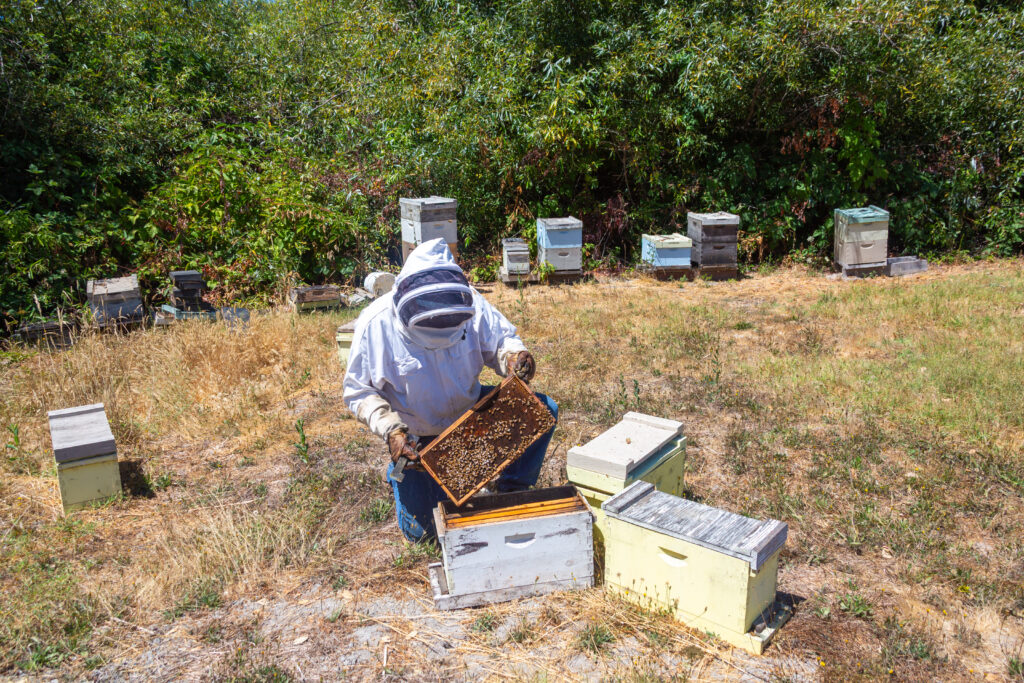
Consistent inspection schedules form the backbone of successful beekeeping. It’s important to open your hive to assess progress, check for problems, and make management decisions. You'll learn what to look for during these inspections, from brood patterns to honey stores to signs of swarming preparation. Knowing when to add your second box is crucial for colony expansion. Beyond following a schedule, you'll eventually develop the skill of reading your bees' behavior and responding to their needs rather than following rigid formulas.
Common Challenges
Real-world beekeeping involves navigating various challenges. Confidence and care is key: Defensive behavior can be triggered by many factors, including something as simple as killing a single bee, which releases alarm pheromones that increase the entire hive's defensiveness. Robbing becomes a serious threat in late summer when nectar is scarce and strong colonies attack weak ones, identifiable by ripped comb and frantic activity. Yellowjackets, ants, wax moths, and other pests will be covered. Varroa mites are the number one killer of bee colonies, making proper treatment protocols essential. We teach how and when to do mite washes and the method for naturalistic powdered sugar treatments. Understanding why mites are so destructive and how to monitor and treat them effectively separates successful beekeepers from those who lose colonies.
Preparing for Winter
Successful overwintering begins months before cold weather arrives. Accurate calculations and interventions are often necessary to ensure bees have adequate honey stores, low mite counts, and a strong winter cluster. Understanding how much honey bees need to consume during winter helps you make informed decisions about supplemental feeding and hive configuration.
West-Coast Specific Information
Why Location Matters
Beekeeping in coastal California presents unique challenges and opportunities compared to other regions. Regional queen mating is complicated by coastal fog and temperature fluctuations, directly impacting those success rate variations. Timing differs significantly from East Coast beekeeping due to our Mediterranean climate with wet winters and dry summers. Local nectar flows from eucalyptus, blackberry, and other regional plants create a forage calendar distinct from other parts of the country. Climate adaptations for drought years and understanding how our weather patterns affect bee behavior are essential for West Coast success.
Local Resources
Building connections with local experts and organizations accelerates your learning curve. The Sonoma County Beekeepers Association provides mentorship, swarm lists, and community support. Since 2012, Beekind has focused on developing strong genetics from untreated hives and creating daughter queens sold with our package bees.
Setting Realistic Expectations
What Beekind Provides
Our approach to beekeeping education rests on several core commitments. We provide honest information about risks and challenges rather than overselling the ease of beekeeping or promising unrealistic success rates. Our protocols are specifically proven for West Coast conditions, not generic advice from beekeeping books written for different climates. Ongoing support through our store and community means you're never alone in your beekeeping journey—we're here for questions, troubleshooting, and guidance throughout the year.